

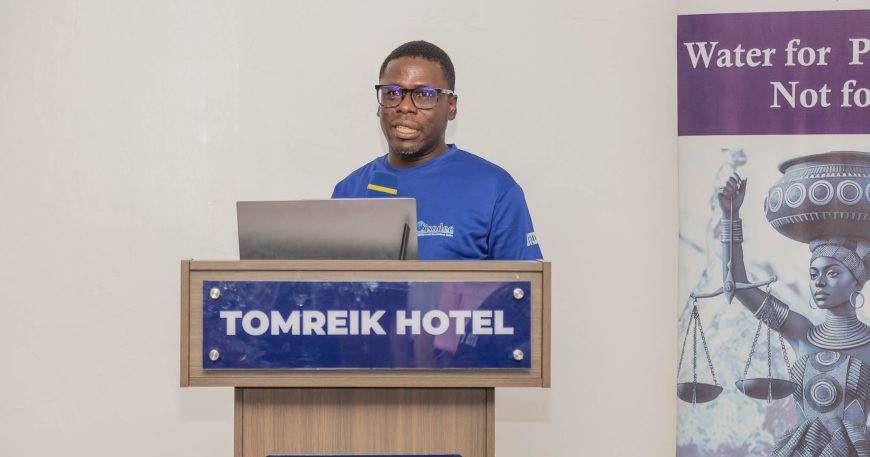
The Coordinator of the Africa Water Justice Network, Mr. Leonard Shang-Quartey has expressed concerns over rising water tariffs and high connection fees, cautioning that such costs could exclude vulnerable populations from accessing essential services.
Mr. Shang-Quartey also advised against the growing use of prepaid water meters, stating that they risk further limiting access for low-income households.
Despite these challenges, the Coordinator highlighted opportunities for improvement, pointing to a strong willingness among citizens to pay for reliable water services. He also underscored the potential of community-based water management systems and the presence of institutional frameworks that, if strengthened, could enhance equitable access to water.
Mr Shang- Quartey made these remarks during a presentation at the official launch of the National Water Justice Campaign in Accra recently.
Mr Shang- Quartey stressed that water should be regarded as a fundamental human right rather than a commodity, despite increasing pressures toward commercialization within the sector
The Launch event was put together by the Integrated Social Development Centre (ISODEC) in collaboration with Water Justice Network Ghana and supported by STAR-Ghana Foundation under the Action for Voice, Influence and Inclusive Development (AVID II) project.
The Campaign aims to amplify citizens’ voices and push for the recognition of water as a fundamental human right for all communities in Ghana, while seeking to promote equitable and affordable access to water, positioning it as a critical driver of national development.
in his welcome address, the Executive Director of ISODEC, Mr Samson Salifu Danse, called for urgent collective action to protect water as a fundamental human right.
Mr Danse urged stakeholders to prioritize equitable access to clean and affordable water, stressing that “water is for people, not for profit.”
He emphasized that access to safe water remains a major challenge for many Ghanaians despite its essential role in daily life.
Mr Danse used the occasion to urge policymakers, civil society, and citizens alike to prioritize water accessibility as a matter of urgency, stressing that access to clean water is not a privilege, but a basic human right essential for dignity, health, and sustainable development
on his part, the Chairman of Water Justice Network, Mr Geoffrey Ocanssey, told participants that the Network aims to consistently assess the state of water access in the country, identify key barriers to progress, and promote practical, rights-based solutions.
He added that the Network also seeks to build a unified and active coalition capable of driving sustainable change.
Participants were encouraged to collaborate, share ideas, and develop actionable strategies to address water challenges in Ghana.
The launch highlights the global framework of United Nations Sustainable Development Goals, particularly Sustainable Development Goal 6, which calls for clean water and sanitation for all by 2030. Advocates argue that without urgent action, Ghana risks falling short of this target.
Source: ISODEC Communications

