

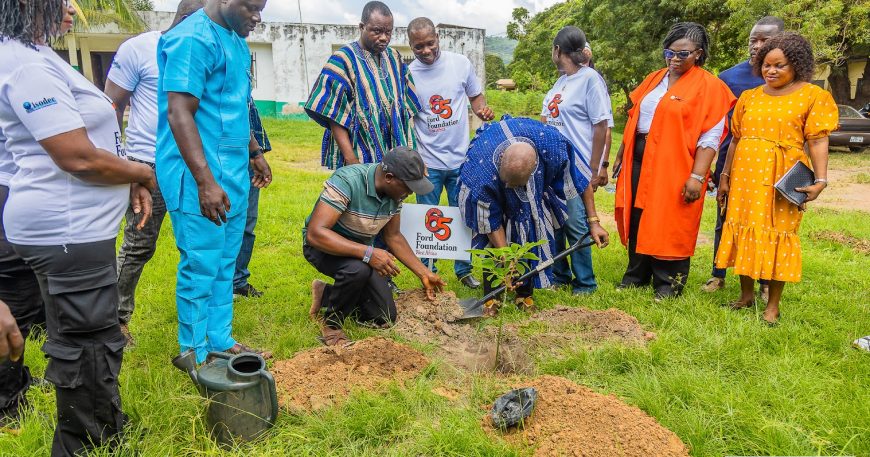
The Integrated Social Development Centre (ISODEC), in partnership with the Ford Foundation, has celebrated the Foundation’s 65th anniversary in West Africa with a symbolic tree-planting ceremony at the forecourt of the Shai-Osudoku District Assembly.
The event, themed “From Nation-Building to Social Justice,” highlighted the Foundation’s enduring legacy in advancing education, democracy, social justice, and environmental sustainability across the region.
The celebration brought together district officials, traditional leaders, civil society representatives, students, and community members to honor the Ford Foundation’s contributions to development and equity in Africa.
Delivering the keynote address, Bernard Anaba, Head of Programmes and Policy at ISODEC, lauded the Foundation’s decades-long support for initiatives that promote social and economic justice, natural resource governance, and fiscal transparency.
“For six and a half decades, the Ford Foundation has been an indispensable catalyst for change—a reliable partner driving progress across West Africa,” Mr. Anaba said.

“Their commitment has strengthened institutions, empowered communities, and advanced social justice, democracy, and environmental sustainability.”
He outlined ISODEC’s collaboration with the Foundation since 2014, noting that their partnership has supported efforts to curb illicit financial flows, promote equitable management of natural resources, and improve domestic revenue mobilization in Ghana.
Mr. Anaba further emphasized the urgency of addressing climate change, describing it as “one of the most pressing challenges facing West Africa,” and praised the Ford Foundation’s commitment to climate justice and community resilience.
“When other donors have left, the Ford Foundation has stayed with us. Their support continues to nourish civil society—the taproot from which communities across Africa draw strength,” he said.
Local government commends Ford Foundation’s impact
Speaking on behalf of the Shai-Osudoku District Assembly, Rev. Emmanuel Ablorh Adjei commended the Foundation for its longstanding role in empowering local communities and advancing inclusive development.
He highlighted the symbolic significance of the tree-planting initiative, describing it as “a living metaphor” for Ford Foundation’s legacy and ongoing impact.
“Just as trees take root and grow stronger over time, the Foundation’s commitment to empowering individuals, strengthening institutions, and promoting sustainable development continues to flourish,” Rev. Adjei stated.
He also noted that the inclusion of schoolchildren in the ceremony represented a shared commitment to embedding environmental consciousness in the next generation.

“By teaching our young people about environmental responsibility, we are sowing the seeds for a more sustainable and equitable future,” he added.
A Legacy of philanthropy and partnership
Since its first grant in Nigeria in 1958, the Ford Foundation has invested over $280 million in programs supporting higher education, democratic governance, and social inclusion in Africa.
Its current initiatives include a $20 million West African Democratic Fund to strengthen democracy and civic participation, and a $420 million global pledge to advance gender equality and combat gender-based violence.

ISODEC reaffirmed its commitment to continuing this partnership by promoting community-led climate adaptation, land restoration, and equitable access to natural resources in Ghana.

The ceremony concluded with the planting of 65 trees—symbolizing each year of the Foundation’s work in West Africa—across various locations in the Shai-Osudoku District.
“These trees are not just a tribute to Ford Foundation’s history,” Mr. Anaba remarked, “but a living promise to protect our environment and nurture the roots of justice and equality for generations to come.”
Source: GHEXTRACTIVES.COM

