

A new study commissioned by Resource Network Justice Ghana has revealed that despite Ghana earning more than US$10 billion in petroleum revenues between 2010 and 2024, investments funded through oil revenues have not adequately addressed the needs of women, persons with disabilities (PWDs) other vulnerable groups.
According to the report, a significant portion of Ghana’s petroleum revenue, managed under the Petroleum Revenue Management Act, has been allocated through the Annual Budget Funding Amount (ABFA) to support national development priorities such as education, health, agriculture, and infrastructure.
However, the study found that many of these projects remain “gender-blind” and socially neutral, with no intentional framework to ensure Gender Equity and Social Inclusion (GESI).
The assessment, which also examined allocations from the District Assemblies Common Fund (DACF) and the Disability Fund, involved desk reviews of national and district-level data, as well as key informant interviews with officials from the Public Interest and Accountability Committee, the Ghana Federation of Disability Organisations, and District Assembly Planning Officers.
The report further indicated that the 2019 Supreme Court ruling directing that petroleum revenues should form part of Ghana’s “Total Revenue” in calculating DACF allocations has not been fully implemented, resulting in delays in fund transfers.
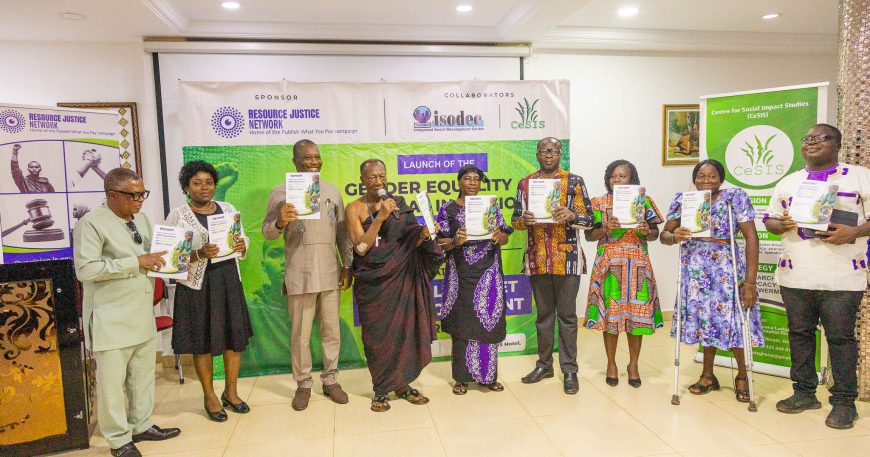
Presenting the findings of the research at the official launch of the Gender Equity and Social Inclusion (GESI) Report at Obuasi in the Ashanti Region, Mrs Charlotte- Kpogli Dzadey, a consultant and gender advocate at Ho Technical University, expressed concern over the management of the Disability Fund, describing allocations as irregular, poorly targeted, and in some instances misused for general welfare services without adequate consultation.
The launch event was organized by the Resource Justice Network, Ghana in collaboration with Integrated Social Development Centre (ISODEC) and theCentre for Social Impact Studies (CeSIS) and supported by the Global Secretariat of the Resource Justice Network.
The event brought together civil society organisations, Youth groups, organizations of Persons with Disabilities, government agencies, Gender activists, representatives from the Public Interest and Accountability Committee(PIAC),the Media among other stakeholders.
Mrs Dzadey noted that the 2019 Supreme Court ruling directing that petroleum revenues should form part of Ghana’s “Total Revenue” in calculating DACF allocations has not been fully implemented, resulting in delays in fund transfers.
She cautioned that without deliberate efforts to promote inclusive development, Ghana’s natural resource wealth could deepen existing inequalities rather than reduce them.
To address the challenges, she recommended amendments to the Petroleum Revenue Management Act to include mandatory GESI provisions and disaggregated data reporting. She also called for inclusive project planning processes that involve women, youth, and PWDs at all levels.
Additional recommendations include the development of a GESI Monitoring and Evaluation Framework for ABFA, DACF, and Disability Fund expenditures, as well as increased support for district-level Gender Desks and Social Welfare Departments.
Mrs Dzadey urged the “government and stakeholders to strengthen civil society and media advocacy to improve public awareness, monitor implementation, and promote accountability in the management of our petroleum revenues.”
In his remarks, Mr. Bernard Anaba, National Coordinator of Resource Justice Network Ghana, commended CeSIS and ISODEC for organizing the event. According to him, the launch of the GESI report could not have taken place in a better location than Obuasi, as it is the hub of Ghana’s natural resources sector and a place of significance to the Publish What You Pay campaign in Ghana.
Mr Anaba stated that natural resources such as gold, diamonds, and oil are very important to Ghana’s development.
According to him, it is difficult to imagine where Ghana would be today without these resources, as they have become an integral part of the lives of many Ghanaians. He acknowledged concerns about the country’s management of these resources, but stressed that this is not the time to give up. Rather, he said, it is time to explore better ways of managing the nation’s natural resources for sustainable development.
He thanked participants for taking time out of their busy schedules to attend the programme and for contributing to its success.
The Ashanti Regional Head of the Department of Gender, Ama Nyantah Boateng, commended the Resource Justice Network for putting the report together. She acknowledged that her mother ministry, the Ministry of Gender, Children and Social Protection, cannot address these issues alone and therefore requires the support and collaboration of civil society organizations.
She said, “When you talk about gender equity and social inclusion, it means that everybody should be on board. It implies that whenever we find ourselves we have to mainstream gender I all the things we are doing whether we are in the formal or informal sector.
She stated that gender equity and social inclusion mean ensuring that everyone is included and given equal opportunities. According to her, “it implies that wherever we find ourselves, we must mainstream gender considerations into all our activities, whether in the formal or informal sector.”
Source: ISODEC Communications

