

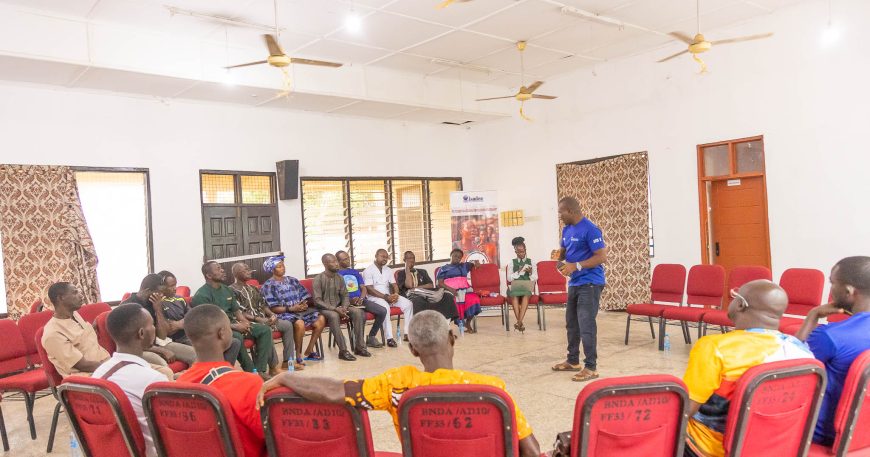
Stakeholders in community water management across the Birim North District have been urged to strengthen their operational structures, improve revenue collection systems to ensure sustainable water service delivery.
The call was made during a Community Water Management and Leadership Capacity Building and Learning Forum organized by the Integrated Social Development Centre (ISODEC) at the Birim North District Assembly recently.
As part of the Action for Voice, Influence and Inclusive Development II (AVID II) project supported by STAR Ghana Foundation, ISODEC in partnership with the Ghana Water Justice Network organized the leadership capacity and learning forum to bring together leaders, practitioners and community stakeholders in the community water management system for learning and dialogue about the best practices, challenges and learnings from the water service delivery.
The forum brought together community water management teams from across the district to learn the best practices and experiences from the Abirem-Afoso-Mamaso Community Water Management Team (CWMT) otherwise known as Abirem-Afoso-Mamaso Water Board, which has earned recognition for its outstanding performance in managing community water systems.
The remarkable success of the Abirem-Afosu-Mamaso CWMT has earned praise from the Birim North District Assembly, civil society organizations, Community Water and Sanitation Board among others. This achievement motivated ISODEC to organize the learning forum to facilitate experience sharing among water management teams within the district.
Opening the forum, the Head of Policy and Programmes at ISODEC, Mr. Bernard Anaba welcomed participants and encouraged them to pay close attention to the experiences shared by the Abirem-Afosu-Mamaso team.
Mr Anaba noted that the team had adopted innovative management practices that had significantly improved water service delivery in their communities.
“The Abirem-Afosu-Maamaso Water Management Team is doing something extraordinary, and it is important for others to learn from their experiences to improve water access in their own communities,” he said.
During the forum, representatives from various water boards highlighted challenges affecting the effective management of community water systems.
The Old Abirem Water Board reported structural and operational difficulties despite having a newly established management structure comprising a chairman, secretary, treasurer, financial secretary, and technical operations officer. The community’s growing population has increased pressure on its single borehole and pump system. Additionally, the board faces serious
challenges with bill generation, distribution, and revenue collection, as many consumers fail to pay their water bills.
The challenge the Hweakwae waterboard faces is the dependent on the a single pump station which has affected water generation and distribution.
The Amuana Praso Water Board noted that although a management structure exist, the secretary is currently indisposed, affecting operations. The community also struggles with generating and distributing bills and collecting payments from consumers.
At Ntronang, officials highlighted difficulties in using billing software, widespread non-payment of bills, and high electricity costs. According to the board, a significant portion of revenue is spent on electricity charges imposed by the Electricity Company of Ghana (ECG), even when water is not pumped. The board also cited inadequate staffing as a challenge.
The Akoase Water Board reported weak management structures, bureaucratic delays in repair and maintenance works, and high electricity costs that affect operational efficiency. Officials further noted that some board members are not fully aware of water-related challenges because they reside outside the community.
The forum established that the community water management teams are faced with same challenges cross the district. Participants observed that while community water is generally more affordable than privately supplied water, residents in Akoase pay higher rates for community water than for private alternatives. Concerns were also raised about expensive electricity bills despite irregular water supply.
Participants agreed that most water boards have limited capacity in technical operations, billing, revenue generation, and staff recruitment.
To address these challenges, the Abirem-Afosu-Maamaso CWMT shared practical strategies that have contributed to its success.
These included establishing effective management structures consisting of a management team board and technical operations team. Under this arrangement, managers regularly brief board members on operational issues, while boards institute sanctions and corrective measures where necessary.
The team also emphasized the importance of maintaining accurate customer databases, improving bill distribution processes, creating convenient payment points, and developing digital payment systems to enhance revenue collection.
Community sensitization was identified as another critical strategy to encourage consumers to pay their bills and support the maintenance and repair of water infrastructure.
Participants further discussed the need for sanctions against defaulters. Suggested measures included disconnecting water supply to consumers who fail to pay their bills, initiating legal
action against customers who default for more than three months, and publicly exposing individuals involved in illegal water connections.
Effective monitoring and record-keeping, along with the procurement of quality equipment such as water meters and pumps, were also highlighted as essential components of sustainable water management.
Delivering closing remarks, the Head of Operations of the Abirem-Afosu-Maamaso Community Water Management Team Mr Alfred Gyadu urged participants to adopt a business-minded approach to water management.
“Run the management of water as a business,” he advised, stressing that sustainable water service delivery depends on sound management practices, financial discipline, and accountability.
Source: ISODEC Communications
