

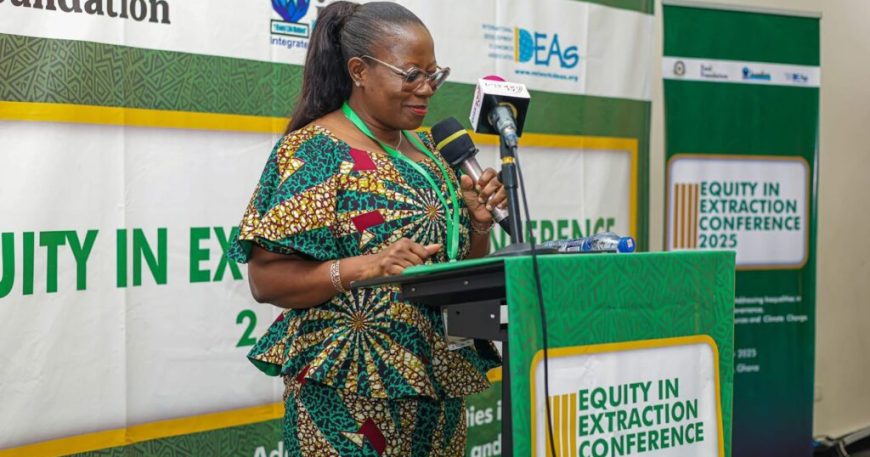
The Director-General of the National Development Planning Commission (NDPC), Dr Audrey Smock Amoah, has urged African governments to ensure that the continent’s natural resources become a source of shared prosperity rather than a driver of inequality and environmental destruction.
Speaking at the High-Level West Africa Conference on Equity in Extraction, organised by the Integrated Social Development Centre (ISODEC) in partnership with International Development Economics Associates (IDEAs) and supported by the Ford Foundation, Dr. Amoah said the governance of natural resources in Africa must undergo a radical shift towards fairness, transparency, and sustainability.
“Equity in extraction is not just a technical or economic goal; it is a moral and developmental imperative,” she stressed.
“Africa’s natural wealth must translate into better schools, hospitals, jobs, and opportunities for our people—not deeper poverty and degraded environments.”
Dr. Amoah illustrated the environmental toll of weak mining governance with the case of River Pra, once a vibrant water source now heavily polluted by unregulated small-scale mining.
“What happened to the Pra is more than an environmental story; it is a story of weak governance, poor economics, and injustice to nature,” she lamented.
She said Ghana’s experience mirrors a wider regional problem in which resource-rich communities bear the environmental costs but receive little economic benefit, a pattern that undermines trust in institutions and fuels social inequality.
According to a UNDP study, only 15–20% of mining revenues remain in local economies, leaving communities impoverished despite sitting atop valuable minerals.
Critical minerals opportunity
With the world’s shift toward clean energy driving massive demand for lithium, cobalt, and other critical minerals, Dr. Amoah cautioned against repeating the mistakes of the past.
“Africa cannot afford another cycle of raw material extraction where others process, profit, and prosper while we bear the environmental scars,” she warned.
She called for a new era of value addition, local content, and regional industrialisation, anchored on strong governance systems and equitable benefit-sharing.
“Our advantage must not only lie in extraction but in transformation. We must build regional value chains and create jobs for our people,” she added.
Climate change and justice
Dr. Amoah linked poor mining governance to worsening climate impacts, noting that Africa contributes less than 4% of global greenhouse gas emissions but faces some of the most severe consequences, including droughts, floods, and coastal erosion.
She urged all African governments to integrate climate-smart mining and environmental justice into national planning frameworks.
Ghana’s upcoming Medium-Term National Development Policy Framework (2026–2029), she said, reflects this priority by focusing on job creation, accountability, and shared prosperity through climate adaptation and decentralised growth.

On his part, Sam Danse, Executive Director of ISODEC said the three-day event seeks to produce a regional roadmap for equitable mineral governance, ensuring that women, youth, and affected communities benefit fairly from extraction.
“Equity in extraction is not a myth but a cornerstone of a just green transition—one that demands fairness, transparency, and accountability for today’s and future generations,” he said.

